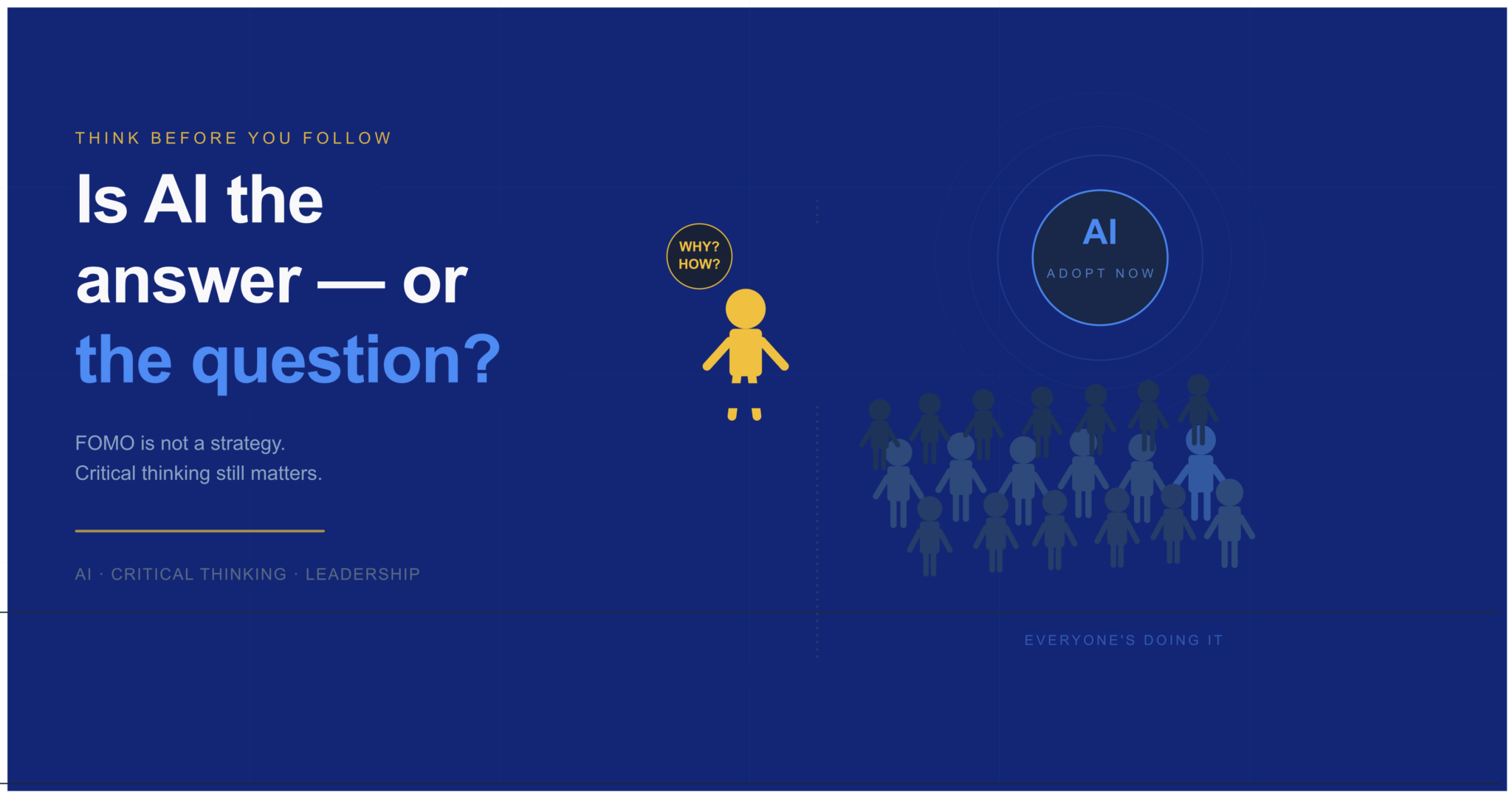
It saddens me to see the decline of independent thinking across society. We have long lacked critical thinking, and that lack has led much of society to be so drunk on AI Kool-Aid that even independent thinking is giving way to AI slop.
Those who have followed me for a while may have noticed that I have not been a big cheerleader for AI deployment. I truly agree that AI is a fabulous new tool, but just because you just got a fabulous new hammer, it doesn’t mean you need to go and hammer everything in sight.
You may also have noticed that I am a big fan of critical thinking; in fact, it is the key thing I teach in my cybersecurity awareness courses. If I could name only one thing that would greatly increase everyone’s overall security, critical thinking would be it. I’m a fallible human being like everyone, and I have fallen for a few phishing campaigns. What always saved me was the techniques I teach in my class, and I caught myself before any damage was done.
People’s tendency to follow the crowd and jump on the latest bandwagon is a great threat to society’s well-being, in my opinion. This is an extension of the lack of critical thinking. I saw this with the Beanie Baby craze in the late 90s, the cryptocurrency hype about a decade ago, and the NFT craze about five years ago. All examples of society buying into the FOMO and greed. A little critical thinking, or even just independent thinking, would have made a big difference. I’m seeing this exact same pattern with the AI hype, folks rushing in based on FOMO instead of critical thinking.
Deploying the right AI tool in the right way can be an incredible force multiplier, but it requires critical thinking and a properly designed solution to a specific problem in a specific way.
If your AI plan boils down to something along the lines of “each employee should be spending at least half their salary on an AI token to prove that they are using AI”, you have a serious problem and are high as a kite on AI weed. The goal of AI should not be to use AI for the sake of using AI; that’s wasteful and irresponsible. That’s like measuring a sysadmin on how high your AWS bill is because you are a cloud-first company.
A lot of the time, a good Python script will solve a problem better than an AI solution. You shouldn’t try to solve every problem with AI; always use the simplest, easiest solution. The most modern and expensive solution is not good for the business; the easiest and least expensive solution is.
We saw this exact same mentality, just to a lesser extent, during the blockchain craze. Everything needed to be on a blockchain when a simple database table would have been the best solution.
With the blockchain hype, the real use cases were like 3% with 97% hype. The AI hype cycle, while overall even stronger than the blockchain hype, has a much sturdier foundation, with about 40% of use cases real and 60% hype. While the use cases may be many and sturdy, the actual deployment isn’t always.
When designing an AI solution, as I said, first make sure the problem is best solved with AI, and then don’t skimp on the solution’s auditability. All solutions, including those best suited to AI, should follow the same design and deployment lifecycle as any other project. Using AI speed as an excuse to short-circuit established project and deployment practices to deploy a substandard solution should not be tolerated. Skipping proper design cycles because “AI can do it faster” is both dangerous and reckless.