

Executive Summary
MikroTik is a Latvian company headquartered in Riga, founded in 1996, with revenue over 400 million Euros in 2023, over 300 employees, and over 800 distributors in 130 countries. All products are designed and developed in Riga in strict accordance with European quality and security standards.
They offer a variety of network gear for enterprises, small businesses, and home networks. Their consumer products are comparable to prosumer products while maintaining a price point of a normal consumer product. Their products are far superior to those of Linksys, TP-Link, and Netgear, while selling for a similar price point (or lower in many cases).
When compared to Cisco’s SMB and small-enterprise product line, they offer the same feature set and quality at a fraction of the price. In many case 1/10th of the price. We define a small enterprise as any enterprise that moves less than 500 Gbps in sustained traffic and has fewer than 2000 employees.
Introduction
MikroTik is a Latvian company that was founded in 1996 to develop routers and wireless ISP systems. MikroTik now provides hardware and software for Internet connectivity in most of the countries around the world. Their experience with industry-standard PC hardware and complete routing systems enabled them in 1997 to create RouterOS, a software system that provides robust stability, control, and flexibility for a wide range of data interfaces and routing. In 2002, they decided to make their own hardware, and the RouterBOARD brand was born. MikroTik HQ is located in Riga, the capital city of Latvia, and has more than 300 employees.
Today, they are a manufacturer of router software and equipment that offers the most user-friendly and flexible operator-level traffic-routing and network-management solutions. Their products are used by Internet service providers, businesses, and individual users to build network infrastructure worldwide. Their goal is to make Internet technologies faster, more powerful, and accessible to a broader range of users.
They have production facilities in Europe and Asia, and they are 100% compliant with all applicable EU laws and regulations. They are 100% European-born and bred, and their entire cycle, from prototype to actual products, takes place in the EU. While some of their assembly takes place in Asia, and some of their chips are from Asia, like all other electronics manufacturers, they maintain complete control over the entire manufacturing cycle. Most importantly, their router and switch OS is 100% developed in the EU. So, there are no worries about influence from governments unfriendly to the EU.
MikroTik Products
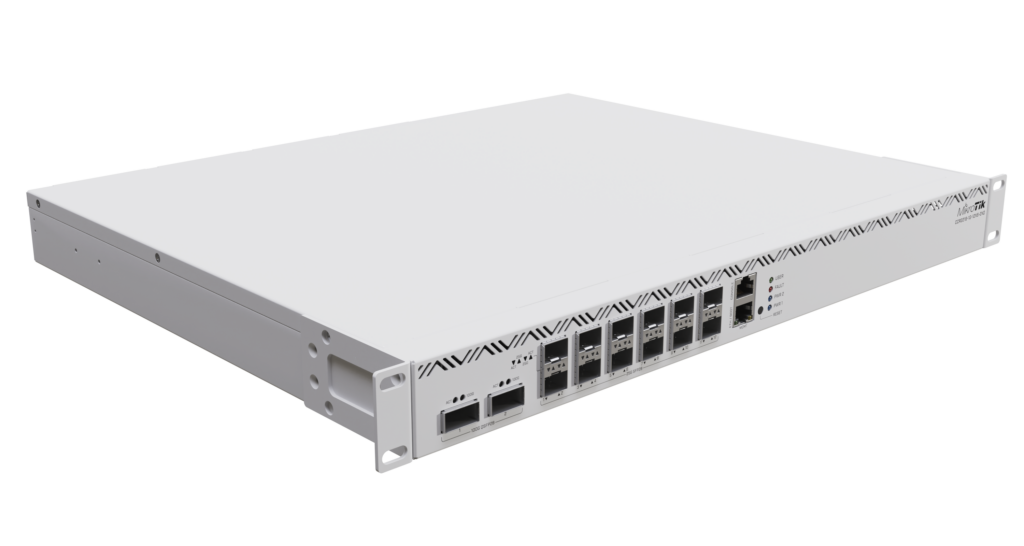
Product selection is not lacking from MikroTik. They currently offer more than 250 different products. Here are the categories they offer
- Enterprise routers (up to 100G routers)
- Switches
- Wireless systems for the Enterprises and ISPs
- Wireless for home and office
- LTE/5G
- IoT products
- 60 GHz PTP Wireless Products
- Various Accessories, including SFP/QSFP
Features
RouterOS is remarkably feature-rich for its price tier. You get BGP, OSPF, IS-IS, MPLS/VPLS, full firewall/NAT, traffic shaping, VPNs (IPsec, WireGuard, L2TP, SSTP, OpenVPN), SD-WAN-like capabilities, and even a built-in Dude network monitor. RouterOS v7 brought significant improvements to BGP implementation, VXLAN, and container support.
Pricing
This is the killer differentiator: save up to 90% compared to comparable Cisco gear over the lifetime of your network.
At the mid-enterprise tier, the price difference ranges from 5:1 to 10:1 compared to comparable Cisco devices, in MikroTik’s favor. How can MikroTik be 1/10th of a comparable Cisco product, you might ask. Simply, they charge a reasonable margin and encourage their distributors to do the same; they publish MSRP prices with reasonable margins. Many large enterprises get 50-70% off the Cisco list price. To do that, your list price needs to be at least 4x your actual cost. MikroTik takes a different approach; they don’t spend a boatload on wining and dining executives or employ an army of marketing folks.
MikroTik focuses on outstanding R&D and engineering, keeping everything in Europe and keeping overhead lean. They let engineering speak for itself and make conservative marketing claims. Also, all licensing fees are included in the hardware cost.
When you buy your gear, your bill breaks down something like this
| Item | Cisco | MikroTik |
|---|---|---|
| Harware | ASR1001-X MSRP ~ $20K | CCR2216-1G-12XS-2SQ MSRP $2795 |
| Software License (Do you actually want an OS on your router?) | Extra, payable every year | Included indefinitely, no extra cost |
| Throughput license (Do you actually want to process 10 Gbps on your 10 Gbps router??) | Extra Extra | Included indefinitely, no extra cost |
| Feature licenses (You want to do more than basic stuff) | That’s going to cost you | Included indefinitely, no extra cost |
| Support contract (8x5xNBD) | 15–20% extra each year | Included indefinitely, no extra cost |
| Software Updates | Requires a software license | Included indefinitely, no extra cost |
| Estimated 5-year TCO for a mid-size enterprise edge deployment (2–4 routers) | $120,000–$300,000+ after you add up Software License, Throughput License, Feature License, and support | $15,000–$40,000 |
MikroTik’s weaknesses
As great as MikroTik products are, they have their weaknesses, and they are not ashamed to admit them.
- Their documentation is a bit lacking
- If you require more than 16 ports in a single router, MikroTik can’t help
- They don’t offer any devices with 40Gbps ports, only 25Gbps and 100Gbps
- Some very advanced VxLAN and MPLS features are missing or immature.
- They don’t support EIGRP, AnyConnect, Meraki, or other proprietary Cisco protocols
- They don’t integrate into the Cisco ecosystem (this was a huge disadvantage, according to Mistreal Le Chat AI chatbot)
- Doesn’t have the Cisco Logo
- No 24×7 support option, need to depend on distributors and 3rd party consultants at a fraction of the price of a Cisco smart contract (Tech support)
LLM/AI Summary
These days, it’s unheard of not to include LLM/AI in all writing. While some of the facts and figures here came from Claude or Le Chat, they were all humanly verified, and the text was all composed by a human. However, to satisfy the requirement for an AI text, here is a direct quote from Claude summarizing the difference
MikroTik offers perhaps 80–90% of the functionality most enterprises actually use, at 10–20% of the cost. The gap is real, but it’s mostly in support infrastructure, ecosystem depth, and organizational risk tolerance rather than raw technical capability.

